RC Car Glossary: 45+ Terms Every Beginner Should Know

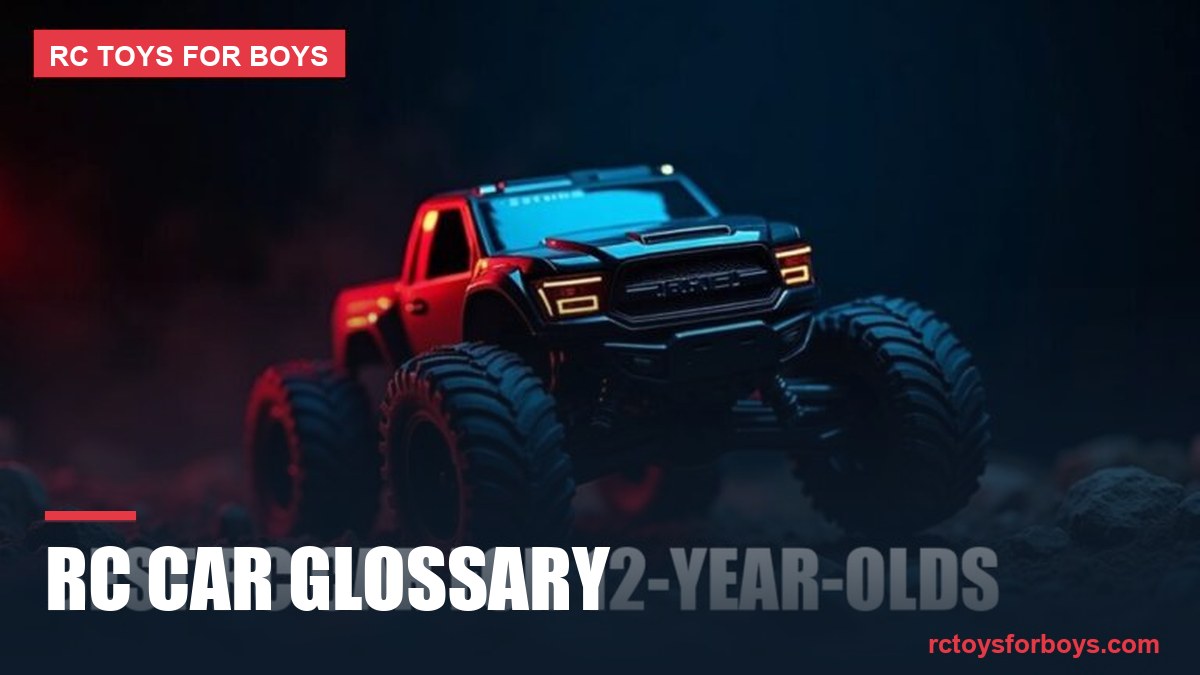
If you’re new to the hobby, the jargon can feel like a foreign language. Drivers at the track rattle off rc car terms like “BNF,” “LiPo,” and “diff” as if everyone was born knowing them. The truth is, every one of us started out nodding along and quietly looking things up later. This glossary fixes that. Below you’ll find 45+ of the most common RC car terms, grouped into plain-English sections so you can find what you need fast and actually understand what the hobby shop, the box, or the forum is talking about.
Bookmark this page. Whether you’re shopping for a first car, reading a product description, or troubleshooting in the garage, having these definitions handy will make the whole hobby click a lot faster.
Buying & Assembly Terms (RTR, BNF, and Friends)
The first wall of acronyms most beginners hit is on the box itself. These tell you how much of the car is built and what you’ll need to add before you can drive.
- RTR (Ready-to-Run)
- The car comes fully assembled with a transmitter, receiver, and usually a battery and charger. Just charge up and drive. Best choice for most beginners.
- BND (Bind-N-Drive)
- Includes everything except a transmitter. You “bind” the included receiver to a radio you already own.
- RTF (Ready-to-Fly)
- The aircraft equivalent of RTR, common on the broader RC market for planes and drones.
- BNF (Bind-N-Fly)
- An aircraft that includes a receiver but no transmitter, so you bind it to a compatible radio.
- ARR / ARTR (Almost-Ready-to-Run)
- A mostly built roller that still needs you to add electronics like a radio, ESC, or motor.
- Kit
- A box of parts you assemble yourself. No electronics included. Great for learning how a car works, but not a beginner’s first weekend project.
- Roller
- A complete rolling chassis with no electronics installed, sold to drivers who want to choose their own motor, ESC, and radio.
Power & Electronics
This is the heart of any electric RC car. Understanding these RC car terms will save you money and prevent a lot of melted parts. If you only learn one section, make it this one.
- ESC (Electronic Speed Control)
- The component that takes signal from the receiver and controls how much power flows from the battery to the motor. It manages throttle, braking, and reverse.
- Brushed Motor
- A simple, affordable motor that uses physical carbon brushes. Reliable and beginner-friendly, but wears over time. See brushless vs brushed motors for a full comparison.
- Brushless Motor
- A more efficient, more powerful motor with no brushes to wear out. Runs cooler, lasts longer, and costs more upfront.
- Turns (T)
- A rating for brushed motors. Fewer turns (like 17T) means more speed; more turns (like 27T) means more torque and longer runtime.
- KV
- A brushless motor rating for RPM per volt. Higher KV spins faster; lower KV makes more torque.
- LiPo (Lithium Polymer)
- A lightweight, high-power rechargeable battery. Delivers strong performance but requires proper charging and storage care.
- NiMH (Nickel-Metal Hydride)
- An older, more forgiving battery chemistry. Heavier and less punchy than LiPo, but very beginner-friendly and hard to damage.
- mAh (milliamp-hours)
- A measure of battery capacity, or how much “fuel” it holds. Higher mAh generally means longer runtime per charge.
- C Rating
- How fast a battery can safely discharge its power. A higher C rating can deliver more current to the motor.
- S Count (1S, 2S, 3S)
- The number of cells in a LiPo pack, which sets its voltage. Each cell is about 3.7V, so a 2S pack is roughly 7.4V. More cells usually means more speed.
- LVC (Low-Voltage Cutoff)
- A safety feature in the ESC that reduces or cuts power before a LiPo drains too low and gets damaged.
- BEC (Battery Eliminator Circuit)
- A circuit, usually built into the ESC, that powers the receiver and servo from the main battery so you don’t need a separate one.
Need a refresher on packs, chemistries, and chargers? Browse our guide to RC batteries & chargers before your next upgrade.
Drivetrain & Chassis
These RC car terms describe how power gets from the motor to the wheels, and how the car is built underneath.
- Chassis
- The main frame or “skeleton” of the car that everything else bolts onto.
- 2WD (Two-Wheel Drive)
- Power goes to two wheels only, usually the rear. Lighter and cheaper, but less grip.
- 4WD (Four-Wheel Drive)
- Power goes to all four wheels for more traction and control, especially on loose surfaces.
- Diff (Differential)
- A gear set that lets the left and right wheels spin at different speeds when cornering, so the car turns smoothly.
- Spur Gear
- The large main gear driven by the motor’s small pinion gear. Often a designed-to-break part that protects pricier components.
- Pinion Gear
- The small gear on the motor shaft. Swapping pinion or spur sizes changes your gearing for more speed or more acceleration.
- CVD / Driveshaft (Dogbone)
- The shafts that transfer power from the diffs to the wheels. CVDs are a smoother, more durable upgrade over basic dogbone shafts.
- Slipper Clutch
- An adjustable clutch on the drivetrain that slips slightly under hard acceleration to protect gears and reduce wheelspin.
- Shock / Damper
- Oil-filled cylinders that control suspension movement, soaking up bumps and jumps to keep the tires planted.
- Ball Bearing
- Low-friction bearings that let shafts and wheels spin freely. Better than plastic bushings for speed and durability.
Control & Radio
The radio system is how you actually talk to your car. These are the RC car terms you’ll hear around steering, throttle, and signal.
- Transmitter (TX)
- The handheld controller you hold to steer and throttle. Most car radios use a pistol-grip with a steering wheel and trigger.
- Receiver (RX)
- The small unit inside the car that receives signals from the transmitter and relays them to the ESC and servo.
- 2.4GHz
- The modern radio frequency band nearly all RC cars use. It lets many cars run at once without interfering with each other.
- Binding
- The pairing process that links a specific transmitter and receiver so they talk only to each other.
- Servo
- A small geared motor that moves the steering. Torque and speed ratings tell you how strong and quick it is.
- Channel
- One function the radio controls. Two channels (steering and throttle) is standard for cars; extra channels can run lights or other gear.
- Trim
- Fine adjustments on the transmitter that center your steering or throttle so the car drives straight.
- Dual Rate / EPA
- Settings that limit how far the steering travels, helping you tame a twitchy car or dial in precise control.
- Failsafe
- A safety setting that cuts the throttle if the car loses radio signal, so a runaway doesn’t take off.
Tires & Terrain
Where the rubber meets the dirt. These terms cover grip, wheels, and the surfaces you’ll drive on.
- Foam Insert
- The foam ring inside an RC tire that supports it and controls how it flexes under load.
- Pin / Tread
- The knobs and pattern on a tire. Tall pins dig into loose dirt; lower profiles suit hard-packed or indoor surfaces.
- Hex
- The hexagonal wheel adapter (commonly 12mm) that connects the wheel to the axle. It must match your wheels.
- Traction
- How much grip the tires have on a surface. Too little causes spin and slide; the right tire transforms how a car drives.
- Camber
- The inward or outward tilt of the wheels viewed from the front. Tuning camber changes cornering grip and tire wear.
- Ride Height
- How high the chassis sits off the ground. Higher clears obstacles; lower improves stability and handling.
Vehicle Types & Hobby Slang
Finally, the everyday language that describes what kind of car you have and how the community talks about driving it.
- Scale
- The size of the model relative to a real vehicle. 1/10 scale is the most popular all-around size; 1/8 is bigger, 1/18 and 1/24 are smaller.
- Buggy
- A lightweight off-road car with exposed wheels, built for speed and jumps on dirt tracks.
- Truggy
- A cross between a buggy and a monster truck, with bigger tires than a buggy but a racier build.
- Short Course Truck (SCT)
- A durable, covered-body off-road truck modeled after desert racing trucks. Forgiving and popular with beginners.
- Monster Truck
- A big-wheeled, high-clearance truck built for bashing, jumps, and rough terrain over outright speed.
- Crawler
- A slow, high-torque 4WD built to climb rocks and crawl over obstacles. It’s about control and finesse, not speed.
- On-Road / Touring Car
- A low, sleek car designed for smooth pavement and high cornering speeds.
- Basher
- A tough car built for fun, jumps, and abuse rather than competition. “Bashing” is just driving for fun, anywhere you like.
- Nitro
- A car powered by a small engine that burns nitro fuel instead of a battery. Loud and realistic, but more maintenance than electric.
- Electric (EP)
- A battery-powered car. Quieter, cleaner, and lower-maintenance than nitro, and the standard for most beginners.
- Punch
- How aggressively the car delivers power off the line. High punch feels snappy; low punch feels smooth.
- LOS (Loss of Signal)
- What happens when your car drives out of radio range. Good gear triggers the failsafe instead of running away.
Learn these and you’ll read any product page or forum thread with confidence. Want to see how the numbers translate into real-world performance? Check out our breakdown of how fast RC cars go and put your new vocabulary to work.
Frequently Asked Questions
What does RTR mean on an RC car?
RTR stands for Ready-to-Run. It means the car comes fully assembled with a transmitter and receiver, and usually a battery and charger included. You charge the battery and drive, with no building required. It’s the easiest starting point for beginners.
What’s the difference between brushed and brushless motors?
Brushed motors are simpler and cheaper, using carbon brushes that wear over time, which makes them great for beginners. Brushless motors have no brushes, so they run cooler, last longer, and make more power, but they cost more upfront. Brushless is the common upgrade once you want more speed.
Is LiPo or NiMH better for a beginner?
NiMH batteries are more forgiving and harder to damage, which makes them a safe, low-stress choice when you’re starting out. LiPo packs are lighter and far more powerful but demand careful charging and storage. Many beginners start on NiMH and move to LiPo as they get comfortable.
What does scale mean in RC cars?
Scale describes the model’s size relative to a full-size vehicle. A 1/10 scale car is one-tenth the size of the real thing and is the most popular all-around size. Larger scales like 1/8 are bigger and more powerful, while 1/18 and 1/24 are smaller and great for indoor or tight spaces.
What is an ESC and do I need one?
An ESC, or Electronic Speed Control, manages the power flowing from your battery to the motor and handles throttle, braking, and reverse. Every electric RC car needs one. If you bought an RTR car, the ESC is already installed, so you usually only think about it when upgrading or replacing parts.
Similar Drone Picks
🏁 Don't Overpay for Your Kid's Next RC Toy
Get our free Dad's RC Buying Guide + weekly deal alerts on the best RC cars, trucks & drones. No spam, just the good stuff.